
The culture and habit of regularly drinking coffee and tea have permeated our societies.
Indeed, when we want to enjoy a pleasant time with friends and loved ones, need a little boost, or perhaps gather our thoughts and spend some time alone in peace while enjoying a familiar taste — in all these and many other situations, tea or coffee inevitably become our companions. They are literally associated in our minds with feelings of comfort, joy, and respite from our problems.
In a certain sense, we are simply trained to think and act this way; it has become our habit, thanks to family traditions and the influence of society, the film industry, and active marketing.
Effectively, the substances contained in coffee and tea actively stimulate the nervous system and the production of certain hormones that create a feeling of carefreeness and pleasant excitement.
But is it really safe to drink several cups of these beverages daily?
Let’s try to figure this out together, using the approach and recommendations of Tibetan medicine.
From the point of view of this ancient healing system, coffee is considered to have a bitter taste.
According to Tibetan medical theory, the bitter taste is formed by the elements of wind and water. The bitter taste has a cold and rough nature. These qualities actively increase the vital principle of Lung (Wind), which, as we know, is closely connected to the nervous system and all movements, including thought.
Short-term effects of taking coffee include an excited state of increased tone, an accelerated heart rate, a feeling of chilliness, possible tremors, and bloating. All of this is caused by an increase in Lung. If we haven’t yet developed a habit of overuse and the body as a whole is in a stable state of balance, we may experience a pleasant state of alertness without pronounced side effects. In the short term, stress hormones will decrease, and we will feel temporary relief and inspiration.
But what will we observe in the long term with excessive use?
Constant restlessness, anxiety, increased excitability, mental confusion, poor sleep, irritability, and decreased performance — as well as internal organ problems such as impaired digestion and weakened kidneys. And, of course, if these problems continue to accumulate, this will inevitably lead to serious chronic disorders.
What constitutes too frequent use is certainly an individual matter. Age, constitution, season, and other factors must be taken into account. If a person has a high Wind element in their constitution — short stature, thin body, often feeling cold, etc. — it’s quite possible that even one cup a day will quickly cause problems with regular consumption, especially if they are approaching old age and the season is summer. A large, calm, middle-aged person will likely not notice any side effects from regularly drinking one cup of coffee a day, but whether they can tolerate more without consequences is, again, a personal question.
And what about tea?
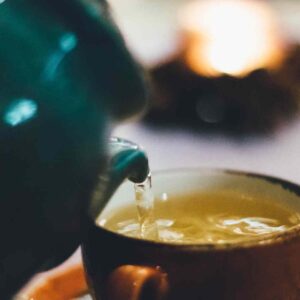 Tea, both black and green, has a bitter and slightly astringent taste — both flavors contain the Wind element and have a cold and rough nature. Consequently, drinking tea inevitably increases Lung function, and the descriptions of its effects and side effects are not very different. Coffee is generally slightly coarser, and caffeine’s effect is more pronounced than that of tea. Therefore, with regular weak black tea, both the energizing effect and the development of negative effects will be slightly less pronounced. However, if you regularly and heavily drink amino acid-rich Chinese teas or brew regular tea too strongly, there won’t be much difference.
Besides controlling the amount of coffee and tea you drink, you can certainly compensate for the coolness and coarseness of coffee and tea in various ways — but that’s a topic for another article!
There’s also a legend in modern urban society that some types of Chinese tea aren’t energizing but rather calming, or that they have a warming nature rather than a cooling one. But let’s take a closer look — their taste is still more bitter and astringent; the stimulating effect may be less noticeable and slightly refined, but it remains a stimulating effect, so all the previous conclusions are still relevant. Of course, a delicate oolong with a floral aroma will invigorate very gently and pleasantly; pu-erh, due to its special fermentation and aging, is not as cold in its properties and therefore is less disruptive to digestion; and Dian Hong is believed to add warmth to the kidneys, but their nature remains cool. Even teas processed using GABA technology and containing gamma-aminobutyric acid, which in itself has a calming effect, still contain caffeine and tannins, so there will be a combined effect. However, in any case, the Wind (Lung) will inevitably be activated and increased.
The final advice of Tibetan medicine is always to observe your ever-changing individual condition and be mindful of your diet and lifestyle, always striving for balance.
If you’re interested in learning more about how food, drinks, and lifestyle influence health and balance, you can explore our Educational Program on Diet According to Tibetan Medicine, where we study these principles in depth and apply them to daily life.
Stay healthy!
